Ross Lake Wildlife Area is an easy place to find the first flowers of spring. During February and March, hundreds of skunk cabbage flowers rise from muck found just a few feet north of the parking area at the end of Hydell Road, along the lakes west shore.

First flower; Skunk cabbage (
Symplocarpus foetidus) blooms through snow at Ross Lake Fen, Ross County, Ohio.
is just east of Chillicothe, Ross County, Ohio. The fen is small, a little known slope-fen* formed along the northeast flank of a ravine cut into a sandy glacial terrace left by Illinoisan glaciation (the glaciation prior to the most recent Wisconsin). It's easy to find, but walking through it will be a challenge--you'll need rubber boots!
I call the place, "Ross Lake Fen" because I'm not aware of any other name used for this obscure group of seeps. This fen is located seven miles south, as crows fly, of Kinnikinnick Prairie, the more recognized but degraded fen frequently identified as the furthest south fen in central Ohio.

Skunk cabbage is exothermic, giving off heat***. Its warmth, and foul odor (often described as skunk spray with garlic) carried on the wind, are very attractive to early pollinating species looking for winter kill carrion. A plume of CO2 resulting from high plant respiration may also serve to attract pollinators. Pollinators are rewarded with warmth inside the flower.
Wetland botanists might classify this area as a series of forest seeps, more particularly, skunk cabbage seeps**. A close look, and we find the hydrological and chemical characteristics of a fen, but few calciphiles--plants that love alkaline conditions.
I'd classify this series of seeps, a fen, by functional definition. They result from geological influence driving groundwater flow. Here, groundwater seeps out of a ravine slope cut into a sandy glacial terrace. The unconsolidated terrace sand rests on a layer of clay, a hardpan. The hardpan prevents downward flow, pooling groundwater. Where the hardpan intersects the flank of the ravine, groundwater seeps out. A "perched" water table, atop the clay, drives the seeps. Organic muck is accumulating wherever seep water trickles out along the slope.

The wet green area seen here is a raised mound of organic muck accumulating where groundwater seeps out. The view is east from the western margin of the fen area. Ross Lake is seen at upper right. Skunk cabbage is found in many of these raised areas along the glacial terrace's north-facing ravine slope.
*Amon JP, Thompson, CA, Carpenter QJ, Minor J. 2002. Temperate zone fens of the glaciated midwestern USA. Wetlands 22: 301-317.
**Mack, John J. 2004. Integrated Wetland Assessment Program. Part 2: an ordination and classification of wetlands in the Till and Lake Plains and Allegheny Plateau regions. Ohio EPA Technical Report WET/2004-2. Ohio Environmental Protection Agency, Wetland Ecology Group, Division of Surface Water, Columbus, Ohio.
*** See
here for discussion of exothermic plant physiology
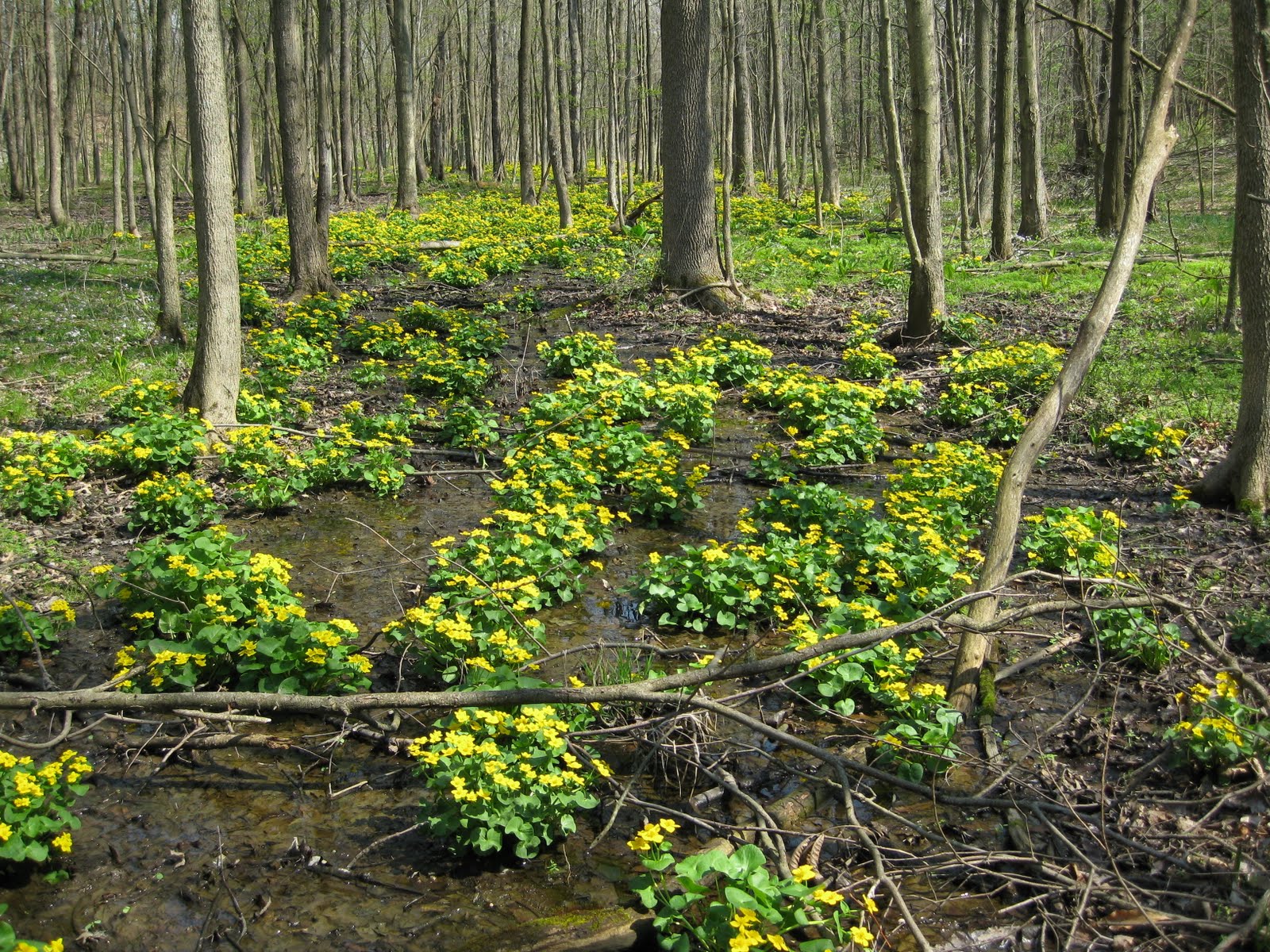 Marsh marigolds in full glory.
 A spring marsh is a beautiful place.
 The best known Midwestern wildflower, common blue violets.
 Common blue violet up close.
 A carpet of spring beauty flowers the flank of the marsh.
 Skunk cabbage plants unfurling giant leaves form a belt along the base of seeping glacial deposits. Marsh marigolds, emergent sparganium marsh, and swamp rose tier the background.
 Sessile trillium, I prefer the name toadshade
 Ramps, a native wild onion and popular spring fare among rural Appalachians and others endowed with adventurous palates and tolerant spouses.
 Boxelder in bloom--trees do it, too.


